German researchers at the Technical University of Munich (TUM) announced that they have discovered and developed a solution to prevent the performance of perovskite solar cells from degrading due to weather. The team, in collaboration with the Karlsruhe Institute of Technology (KIT), the German Institute of Electron Synchrotron Research (DESY) and the Royal Institute of Technology in Stockholm (KTH), revealed the microscopic mechanisms by which this material deteriorates during temperature fluctuations.
The discovery was published in a study in the journal Nature Communications, revealing the degradation that occurs during the initial "aging" stage, during which the relative performance of the battery can drop by up to 60%. The study highlights the importance of thermal cycling and how it affects the degradation of perovskite solar cells at an early stage.
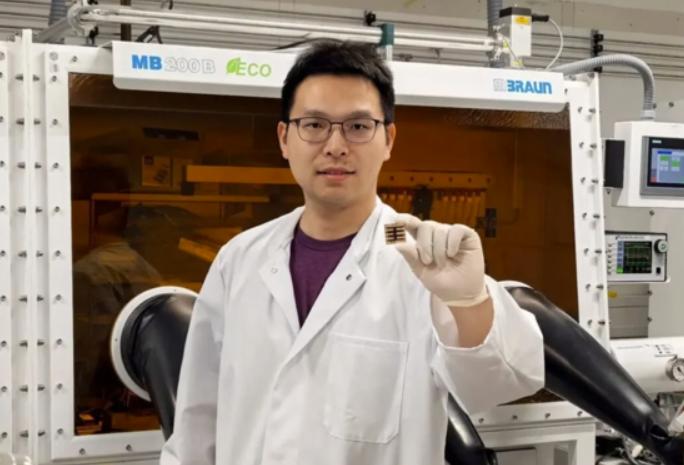
The researchers' approach focuses on the use of specially designed molecular" anchors "to stabilize fragile crystal structures. Photo: Technical University of Munich.
"If we want these batteries to be installed on the roof of every household, we must ensure that they not only perform well in the laboratory, but also withstand the test of the four seasons." Professor Peter Müller-Buschbaum, head of the functional materials department at the Faculty of Natural Sciences at the Technical University of Munich.
Peter Müller-Buschbaum's research team found the microscopic cause of this instability and developed a new design strategy to make the top layer of the laminated solar cell stronger and able to withstand actual environmental conditions. Dr. Sun Kun, the lead author of the study, explained: "We found that this loss is caused by a tug-of-war at the micro level.
. Tension is created within the material and its structure changes-which consumes energy."
The researchers' method focuses on the use of specially designed molecular "anchors" to stabilize the fragile crystal structure. The solution is in another paper-published in ACS Energy Letters-in which the researchers used special organic molecules as spacers to hold the structure together-much like a molecular scaffold.
The results show that the larger organic molecule 1,4-benzyldimethylammonium (PDMA) plays a better anchoring role, thus making a stronger solar cell, which is rapid Heating and cooling can still maintain stability under the action of mechanical stress.
"By understanding these micro-mechanisms, we are paving the way for a new generation of solar modules that are not only extremely efficient, but also durable enough to be used outdoors for decades." Müller-Buschbaum said. The stability issue has long been a major challenge for the commercialization of perovskite technology, as evidenced by multiple research papers published over the past few years, including one published by the University of Sydney last October.