The annual meeting of the 2026 Zhongguancun Forum opened in Beijing today, and the "Top Ten Advances in Chinese Science in 2025" led by the state ministries and commissions was officially announced. The "high-efficiency and stable flexible perovskite-crystalline silicon laminated solar cell technology" jointly researched by Longji Green Energy Technology Co., Ltd. and Suzhou University was listed among them, marking a major breakthrough in the field of next-generation photovoltaic core technology in my country. This is also one of the two major scientific advances in Shaanxi Province.
The theme of the annual meeting of the forum is "deep integration of scientific and technological innovation and industrial innovation. The results of this selection are a model of deep integration and collaborative innovation of production, teaching and research. Longji Green Energy is currently the only photovoltaic enterprise in the world that has the manufacturing capacity of wafer-sized ultra-thin flexible laminated batteries.
At present, the laboratory maximum conversion efficiency of traditional monocrystalline silicon cells has approached the theoretical limit of 29.4. The construction of perovskite materials and crystalline silicon as a laminated structure can make full use of different wavelengths of sunlight, and the theoretical efficiency can reach more than 43%, which is recognized as a new generation of disruptive photovoltaic technology. Among them, flexible laminated batteries based on ultra-thin silicon wafers, with extraordinary lightweight and flexible characteristics, are expected to unlock cutting-edge applications such as wearable devices and building surface photovoltaics. However, the flexible device in the use of repeated bending, temperature changes easily lead to interface delamination failure, stability and life is far less than rigid devices, long-term constraints of its commercialization process.
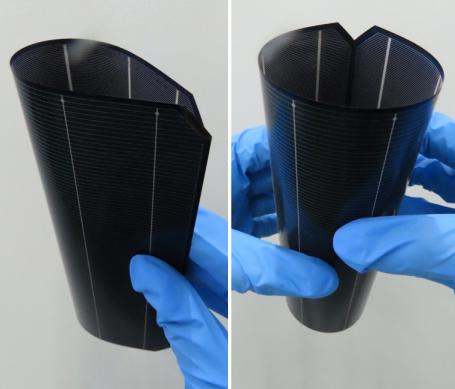
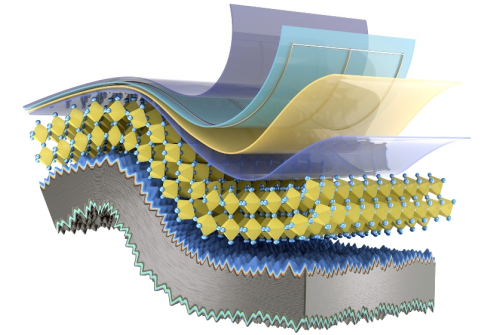
to solve this core problem, Longji green energy Li Zhenguo, Xu Xixiang and he bo team jointly with professor Zhang Xiaohong and Liu Jiang of Suzhou university, innovative design of a "tight and loose" double buffer layer structure. The loose layer can absorb dissipative strain energy like a spring mattress and relieve mechanical stress; the dense layer ensures efficient interface charge extraction and stable connection. This "rigid and flexible" nanoscale layered design, for the flexible laminated battery to put on the "durable armor".
The ultra-thin flexible laminated battery (about 60 microns) based on this technology has been certified by the US Renewable Energy Laboratory in laboratory size with an efficiency of 33.4 percent; the efficiency of 29.8 per cent at all-silicon wafer size is a world record for this type of device. Its power-to-weight ratio is as high as 1.77 W/g, and its lightweight advantage is significant.
The selection of the National Top Ten Scientific Progress of the Year is not only a high recognition of the scientific research strength of Longji Green Energy and the cooperative team, but also a solid foundation for flexible laminated applications. The industry believes that this achievement will strongly promote China's photovoltaic industry from "efficiency leader" to "scene leader" and contribute Chinese wisdom to the global energy transformation.