Recently, Rongjie Energy has made important progress in the field of solid-state lithium metal battery electrolyte materials, and the relevant results have been published in the internationally renowned journal ACS Applied Energy Materials. The research takes Rongjie Energy as the first completion unit. Under the leadership of Dr. Wang Wansheng, the core research and development team composed of Dr. Zhao Ting (postdoctoral fellow in the station, first author and corresponding author of the paper) and Dr. Tao Zhuchen are jointly completed by Professor Xiong Xunhui of South China University of Technology. Around this core structure design, key material formula and preparation process, our company has submitted and accepted a number of national invention patents, marking the company's research and development strength in the field of solid-state battery core materials to obtain international academic recognition and intellectual property protection double blessing.
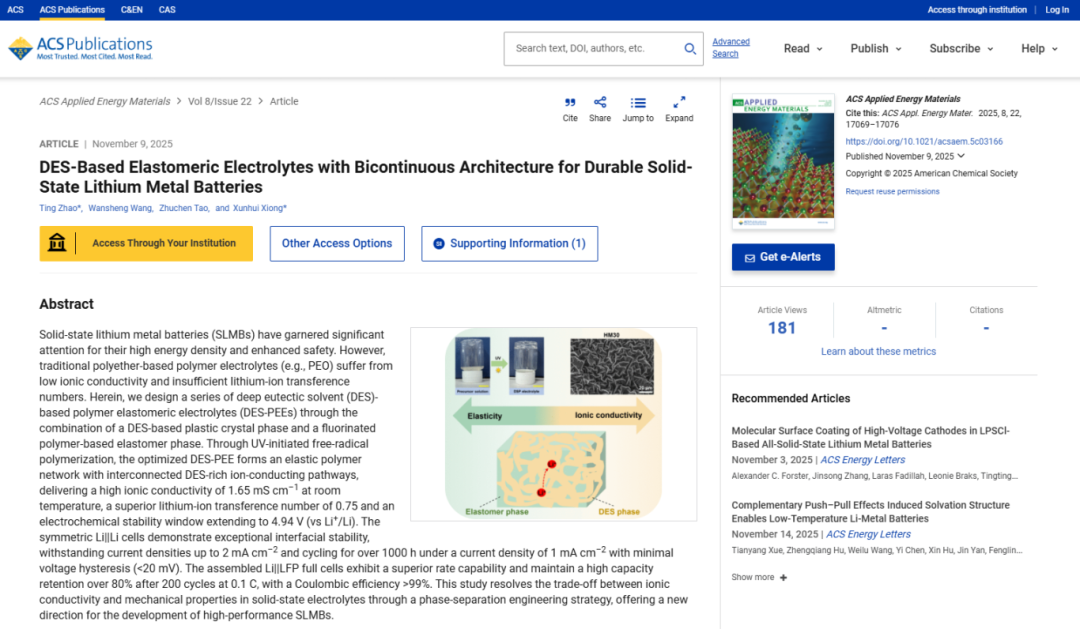
As the core candidate technology of the next generation energy storage system, solid-state lithium metal batteries have always been the focus of research and development in the industry with their energy density far exceeding that of traditional lithium-ion batteries and the safety advantages of no liquid electrolyte leakage and combustion. However, the traditional polyether-based polymer electrolyte (such as PEO) room temperature ionic conductivity is insufficient, it is difficult to meet the needs of practical applications, although fluoropolymers can improve electrochemical stability, but due to the limited movement of the chain segment lead to low ion transmission efficiency, these bottlenecks have long restricted the performance of polymer solid-state batteries breakthrough.
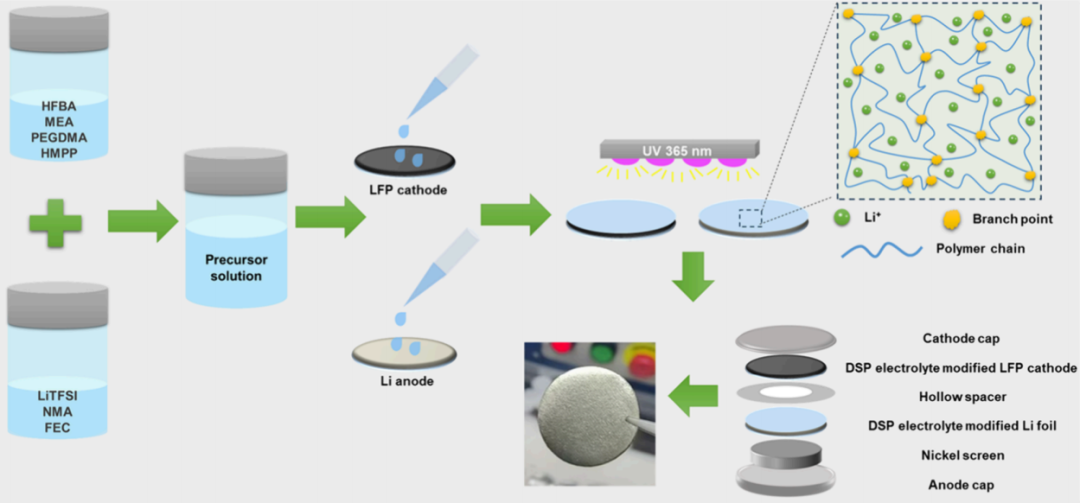
in response to this difficult problem, the research and development team of melting energy innovatively combined the high ion transmission characteristics of deep eutectic solvent (DES) with the excellent mechanical properties and chemical stability of fluoropolymers with ether bonds, and constructed DES-based polymer electrolyte (DES-PEEs) with "bicontinuous phase separation structure" through in-situ ultraviolet induced radical polymerization technology. The structure consists of two sets of networks that run through each other and are each continuous. One is a DES-rich "ion highway", specializing in the rapid transmission of lithium ions; the other is a "mechanical skeleton" composed of fluorinated elastomers, which provides flexible mechanical support and dimensional stability for the entire electrolyte. The two sets of networks are intertwined in three-dimensional space and do not interfere with each other, fundamentally solving the industry pain point that "ionic conductivity" and "mechanical properties" are difficult to balance.
The experimental data show that the optimized HM30 DES-PEEs electrolyte has outstanding performance: the ionic conductivity at room temperature is as high as 1.65mS cm??, which is several times that of the traditional PEO-based electrolyte; The lithium ion migration number reaches 0.75, effectively reducing the ion transmission loss. The electrochemical stability window was expanded to 4.94V(vs Li?/Li), can be adapted to high-voltage positive materials. In the interface stability test, the Li | | Li symmetric battery prepared by the electrolyte showed excellent long-term cycle stability, excellent lithium dendrite inhibition ability and interface compatibility.
after applying it to the full battery system, the lithium metal solid-state battery shows excellent electrochemical performance under all working conditions: in low-rate long-term cycles, the battery shows excellent capacity retention ability and extremely high coulombic efficiency, with outstanding cycle stability; Even under high-rate charge and discharge conditions, the battery can still maintain a stable discharge platform and good capacity retention rate, it shows excellent power characteristics and practical potential. This fully proves that the electrolyte system has the comprehensive performance to meet the requirements of actual energy storage applications.
The breakthrough in DES-PEEs solid electrolyte technology not only reflects the underlying R & D strength of Rongjie Energy in the field of solid-state battery materials, but also provides key technical support for the industrialization of solid-state lithium batteries. In the future, Rongjie Energy will continue to deepen the research and development of new energy materials and energy storage technologies, promote the transformation of more cutting-edge scientific research results, and contribute to the global zero-carbon energy transformation and efficient energy storage development.