According to Xinhua News Agency, in the early morning of January 3, 2026 local time, the US military raided Caracas, the capital of Venezuela, captured President Maduro and his wife and took them out of the country. This incident not only pushed Venezuela into the abyss of sovereignty crisis and social unrest, but also stalled their series of plans to deal with climate change and promote energy transformation. As one of the countries in Latin America that are deeply affected by climate change, Venezuela originally hoped to break its dependence on traditional energy and take into account energy security and climate governance through core measures such as the 2000MW solar energy plan. However, the violent political turmoil has cast a heavy shadow on this transition process, which is related to the long-term development of the country.
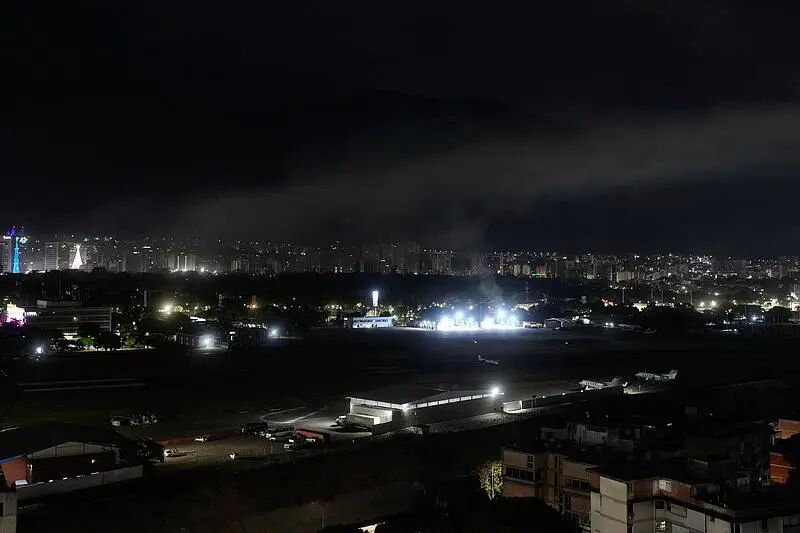
△ Local time on January 3, venezuela was attacked by the United States
take the local landmark photovoltaic project -52.8MW El Vigía photovoltaic power station as an example. this project has entered the final stage, but now it has come to a standstill due to the turmoil. According to the previous plan, El Vigía photovoltaic power station is located in Merida, Venezuela. As the largest photovoltaic project in the country, it is planned to install 94000 photovoltaic modules to provide stable power support for the water supply system of 2290 local households. It is reported that as of mid-December 2025, the main project of the power station has been basically completed, the completion rate of photovoltaic module installation has exceeded 90%, and the commissioning of related equipment has entered the final stage. However, affected by the latest situation, the construction site of the power station has been completely shut down, the construction personnel have been evacuated due to safety risks, and some of the installed equipment is facing the dilemma of no one to maintain. The originally scheduled grid-connected power generation plan has been postponed indefinitely.
El Vigía's setback is a microcosm of Venezuela's photovoltaic industry struggling to survive amid political turmoil. In fact, Venezuela's determination to develop the photovoltaic industry stems from its deep anxiety about the single structure of the energy economy. The country has long relied on hydropower for 99.4 percent of its electricity supply, and multiple large-scale blackouts in 2019-2021 have made the government aware of the urgency of energy diversification. The high proportion of oil export revenue also makes them frequently fall into economic difficulties due to international oil price fluctuations and sanctions.
Under the dual pressures of addressing climate challenges and energy security, Venezuela has previously clearly outlined a blueprint for the energy transition. As early as early as 2023, the government launched a three-year solar energy development plan and proposed the goal of installing 2000MW solar power generation facilities. The 2023-2028 five-year renewable energy development plan released at the same time plans to invest about US $5 billion, focusing on promoting distributed photovoltaic and small wind power projects and striving to double the installed capacity of alternative energy in 2028. In the newly submitted National Independent Contribution (NDC) document, Venezuela clearly stated that it will reduce greenhouse gas emissions by 20% under the baseline scenario by 2035, and plans to invest US $18.4 billion for the emission reduction agenda, of which US $7.8 billion will be invested in the electricity sector, clearly proposing the development of 5.5GW renewable energy, of which at least 3GW will be solar energy and 1GW will be wind energy, and plans to reduce natural gas combustion by 71% between 2025 and 2030.
The above renewable energy development plan is inseparable from Venezuela's unique solar energy resources. Data show that Venezuela is located near the equator, with an average annual sunshine hours of more than 2400 hours. In some areas, the theoretical reserves of annual sunshine resources can reach more than 30 million kilowatts, and the annual available solar radiation exceeds 2000MWh/㎡. The vast Los Yanos grassland and arid areas provide ideal conditions for the deployment of large-scale photovoltaic power stations.
Now, the sudden change of political situation has brought this series of plans to an abrupt end. The process of energy transformation is facing all-round impact. The original high expectation of industrial development blueprint is facing the risk of reconstruction, bringing multiple fatal impacts to the local photovoltaic industry.
The first is a break in policy continuity. The renewable energy development plan promoted during the Maduro government, including support policies such as localized photovoltaic production, tax incentives, and surplus power access, has lost its executive body in a power vacuum. Trump made it clear at the press conference that the United States will form a working group to "manage" Venezuela and promote large US oil companies to enter the country to invest in repairing oil infrastructure. Given the Trump administration's enthusiasm for traditional fossil energy, Venezuela's energy policy is likely to shift back to the traditional oil industry, and renewable energy development plans such as photovoltaics may be shelved. The local efforts to get rid of dependence on a single energy source through the photovoltaic industry may completely deviate from the track under external intervention.
The second is the blocking of external cooperation channels. Venezuela originally planned to obtain photovoltaic technology and financial support through cooperation with China, Russia and other countries, but the United States made it clear that it "does not want other parties to intervene", which will seriously hinder the international cooperation space of Venezuela's photovoltaic industry. At the same time, the United States to maintain the Venezuelan oil embargo policy, will further aggravate the country's foreign exchange shortage plight, so that the import of photovoltaic equipment is more impossible.
From a deeper level, the political turmoil has exacerbated the development bottleneck of Venezuela's photovoltaic industry. The country's long-standing problems of hyperinflation (close to 180 per cent in 2025), skilled brain drain (about 8 million emigration), and aging power grids will only worsen in the midst of instability. For photovoltaic projects such as the El Vig ía power station, even if the situation eases, the restart will require huge capital investment and a stable construction environment, and the current "political-economic-diplomatic-social" quadruple crisis facing Venezuela makes these conditions out of reach. The researchers pointed out that in the context of increased uncertainty, Venezuela's trade and investment order will be severely damaged, the economic situation will further decline, and the implementation of various industrial policies will lose protection.
From the meager installed capacity of 5.32MW in 2019, to the commissioning of the first grid-connected photovoltaic system in 2021, to the large-scale promotion of El Vig ía power station, Venezuela has taken the first difficult step of energy transformation in several years. But this sudden political change brought this process to an abrupt end, becoming a typical case of developing countries facing the risk of external intervention in the energy transition. For Venezuela, the restart of the photovoltaic industry may have to wait until the political situation is stable, but the intervention of external forces has blurred the direction of the energy transition. In the future, there is great uncertainty about whether the new authority will continue the renewable energy policy, or whether the international community can provide it with a stable development environment.