source/liangshan daily
at 16: 00 on December 31, 2025, the tea brown photovoltaic power station in muli county was officially put into operation for power generation. As an important part of the country's first water and scenery integration base, the Yalong River Basin Water and Scenery Integration Base, the operation of the power station has injected green kinetic energy into the base to speed up the construction of a new energy system and ensure national energy security.
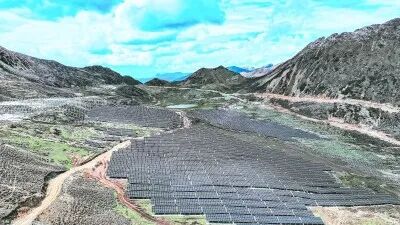
the average altitude of the tea brown photovoltaic power station is as high as 4400 meters. the construction faces multiple challenges such as thin oxygen, strong ultraviolet rays, short effective construction period and complex terrain, it is one of the most difficult ultra-high altitude photovoltaic projects in China.
in view of the difficulties in the construction of the project, the construction party Yalong river company innovated the application of technology and introduced "flexible support" technology to enable photovoltaic panels to cross ravines and steep slopes and adapt to complex mountain terrain. The "air passage" scheme is adopted to transport photovoltaic modules through unmanned aerial vehicles, and the transportation efficiency is 2.5 times higher than that of traditional manual work.
The whole process of project construction adheres to the concept of ecological priority, innovatively implements the mode of "complementary pasture and light" and "complementary grass and light", and raises the photovoltaic support to about 2 meters to ensure the free passage of yaks. The shielding of photovoltaic modules can effectively reduce the evaporation of soil moisture, and the amount of water used to clean the modules can increase the soil moisture, help the growth of plateau pasture, realize the intensive use of land of "on-board power generation and under-board pasture", and promote the development of ecological protection and clean energy to complement each other.
It is reported that the total installed capacity of the power station is 1 million kilowatts, which is currently the largest ultra-high altitude mountain photovoltaic project in China. After it is put into operation, it can deliver about 1.95 billion kilowatt-hours of clean electricity every year, which is equivalent to saving about 600000 tons of standard coal and reducing carbon dioxide emissions by about 1.55 million tons. At the key node of the peak winter, the commissioning of the power station will provide solid support for regional power supply.
The successful interconnection of the power station is a significant manifestation of the effectiveness of the integrated development of water and scenery in the Yalong River Basin. Relying on the built giant reservoir group, the base uses the excellent regulation performance of hydropower to effectively stabilize the intermittency and volatility of wind power and photovoltaic power generation, and convert unstable new energy into stable, adjustable, and high-quality clean electricity. Greatly improve the power grid's ability to accommodate a high proportion of renewable energy and operational safety. With the commissioning of a number of new energy projects such as the Tea Brown Photovoltaic Power Station, the Yalong River Basin Water and Scenery Integration Base has been put into operation with an installed capacity of nearly 23 million kilowatts of clean energy, and a new major breakthrough has been made in the construction of the country's first water and scenery integration base.