The original text is as follows:
Notice of the Hunan Provincial Development and Reform Commission on Issuing the Implementation Plan for Orderly Promoting Direct Connection of Green Electricity in Hunan Province
Xiang Fa Gai Energy [2025] No. 853
To All Relevant Units:
In order to thoroughly implement the spirit of documents such as the “Notice of the National Development and Reform Commission and the National Energy Administration on Matters Concerning the Orderly Promotion of Direct Connection of Green Electricity” (Fa Gai Energy [2025] No. 650) and the “Notice of the National Development and Reform Commission and the National Energy Administration on Improving Price Mechanisms to Facilitate Local Consumption of New Energy Power Generation” (Fa Gai Jia Ge [2025] No. 1192), to promote local consumption of new energy and better meet the green energy needs of enterprises, and in light of our province’s actual conditions, our commission has formulated the “Implementation Plan for Orderly Promoting Direct Connection of Green Electricity in Hunan Province.” This plan is now being circulated to you; please organize and implement it conscientiously.
Attachment: Hunan Province’s Implementation Plan for Orderly Promoting Direct Connection of Green Electricity
Hunan Provincial Development and Reform Commission
December 30, 2025
Attachment
Hunan Province’s Implementation Plan for Orderly Promoting Direct Connection of Green Electricity
Chapter I General Provisions
Article 1 [Purpose and Basis] In order to facilitate the local consumption of new energy, meet enterprises’ demand for green energy use, and promote the scientific and orderly development of green electricity direct-connection projects in Hunan Province (hereinafter referred to as “the Project”), this Plan is formulated in accordance with the National Development and Reform Commission and the National Energy Administration’s Notice on Matters Concerning the Orderly Promotion of Green Electricity Direct Connection (NDRC Energy [2025] No. 650) and the Notice on Improving Price Mechanisms to Facilitate Local Consumption of New Energy Power Generation (NDRC Price [2025] No. 1192), taking into account the actual conditions of our province.
Article 2 [Project Definition] A project refers to a model in which new energy sources such as wind power, solar power, and biomass power do not connect directly to the public grid, but instead supply green electricity via a dedicated transmission line to a single power user, thereby enabling clear physical traceability of the supplied electricity. Among these, a direct-connection line refers to a dedicated power line that connects the power supply directly to the electricity user. Based on whether the load is connected to the public grid, they are classified into grid-connected and off-grid types. Grid-connected projects are integrated into the public grid as a whole, establishing clear physical and responsibility interfaces with the grid. The power source shall be connected on the customer side at the demarcation point between the customer’s and the public grid’s ownership. Off-grid projects have no physical connection to the public power grid; the power source is directly connected to the user’s electrical equipment. For distributed PV systems that are directly connected to the power grid, the relevant national policies, including the “Administrative Measures for the Development and Construction of Distributed Photovoltaic Power Generation,” shall apply. Multiple renewable energy projects are permitted to supply green electricity directly to a single power user via direct-to-consumer green power contracts. Green-power direct-connection projects within industrial parks (including those involving incremental distribution networks) involve the direct supply of green electricity to multiple end-users via dedicated transmission lines. Such projects are not subject to the provisions of this plan and will be regulated separately upon the issuance of specific policies by the National Development and Reform Commission and the National Energy Administration.
Article 3 [Basic Principles] Projects shall be planned and operated in accordance with the principles of safety first, environmental sustainability, balanced rights and responsibilities, and source-load matching, and shall fairly and reasonably assume safety, economic, and social responsibilities.
Article 4 [Applicable Types] In green power direct-connection projects, the load and power generation facilities may be located in different administrative districts, but they must reside within the same power supply service area. The applicable types are as follows. Enterprises with new electricity demand may develop this project as a complementary initiative. Newly added electricity demand includes the load from projects that have obtained the requisite approval (filing) documents but have not yet been completed and put into operation. Among existing load entities that operate their own coal- or gas-fired captive power plants, those that have fully paid the Renewable Energy Development Fund may develop this project and achieve clean energy substitution by reducing the output of their captive power plants. Among the existing power load, export-oriented enterprises with stringent carbon-reduction requirements and computing-power-intensive businesses (including data centers) can directly connect to nearby renewable energy sources to procure green electricity. Among them, extroverted enterprises shall provide the Customs Registration Form for Declaration Units, proof of stringent carbon-reduction requirements, and other relevant supporting documents. Among the non-operational new energy power sources, projects that have not yet commenced grid-connection construction or are unable to connect to the grid due to constraints on power consumption capacity may, after consultation with eligible electricity-consuming entities, be jointly converted into direct green-power supply projects. New energy power sources that are not yet in operation, for which the grid connection projects have been explicitly designated to be invested in and constructed by the grid enterprise, as well as those that are already in operation and whose grid connection projects were likewise funded and built (including buyback arrangements) by the grid enterprise, shall not be converted into green electricity direct-connection project resources. Other newly commissioned new energy power sources, after consultation with eligible electricity load entities, may jointly be converted into green electricity direct-connection project resources. Article 5 [Source-Load Matching Requirements] Grid-connected projects shall, in accordance with the “load-driven generation” principle, scientifically determine the types of new energy power sources and their installed capacity. The scale of electricity demand must be based on sound evidence and supported by reliable data. The project may participate in the spot market primarily through self-generation and self-consumption, with surplus power being fed into the grid as a supplementary arrangement. The annual grid-connected electricity output shall not exceed 20% of the total available generation capacity. The project’s overall annual renewable energy consumption should account for no less than 60% of the total available generation capacity and no less than 30% of the project’s total electricity consumption, with a commitment to continuously increase its self-consumption ratio to at least 35% by 2030.
Chapter 2 Project Approval
Article 6 [Application Procedures and Applicant] Projects shall be led by the load-serving entity for submission. The municipal energy authority shall conduct a preliminary review. Once the preliminary review is approved, the municipal energy authority shall submit a formal document to the provincial energy authority for review and approval. The project may be implemented only after it has been reviewed and approved by the provincial energy authority.
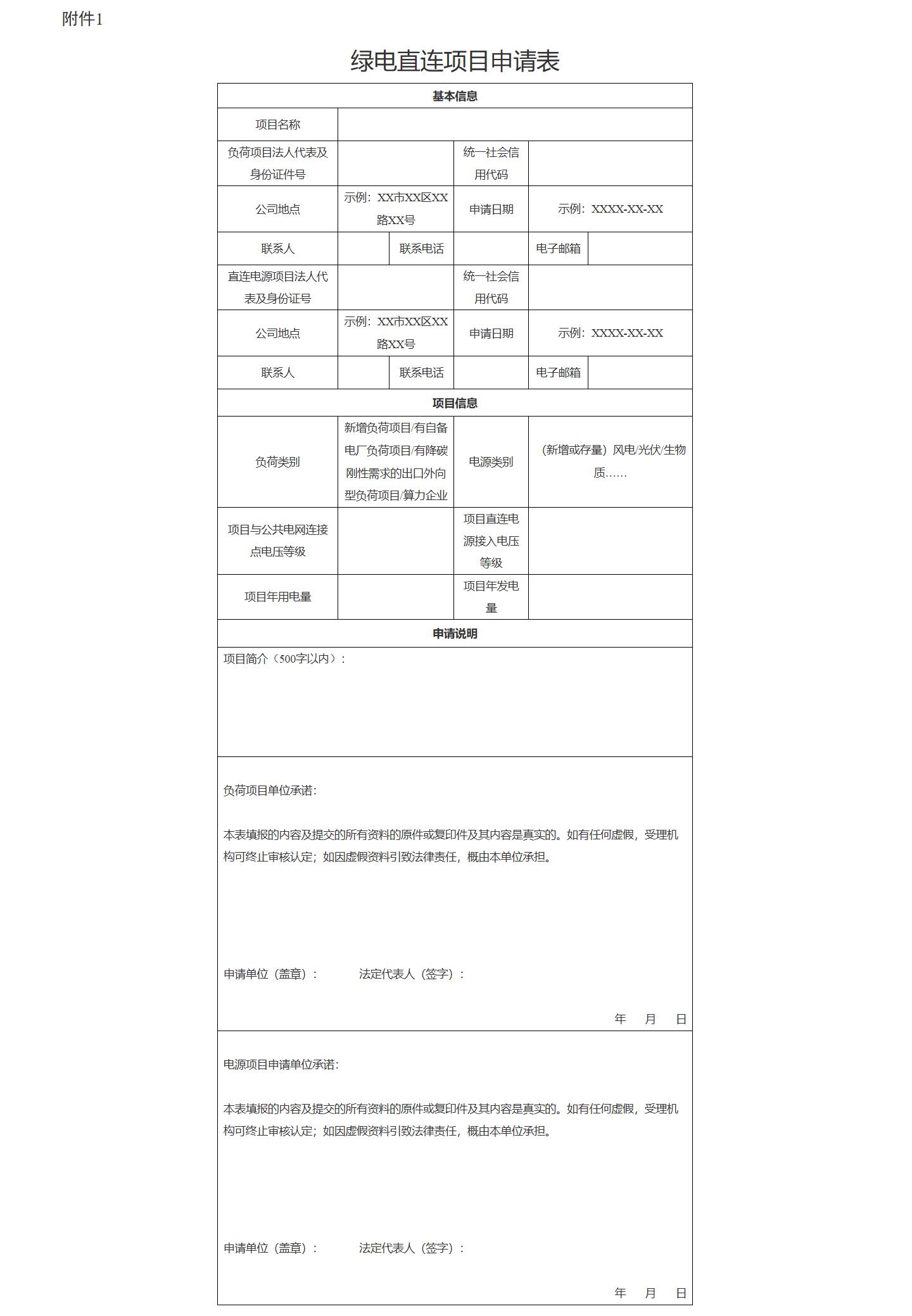
Article 7 [Requirements for Application Materials] When submitting a project application, applicants shall complete the Project Application Form (Attachment 1) and concurrently submit the Comprehensive Project Construction Plan (Attachment 2). In the integrated solution, the declared power exchange value between the project and the public grid, as well as the project’s maximum peak-to-valley difference ratio, shall not exceed the project’s maximum load power and its peak-to-valley difference ratio, respectively. Direct-connection power projects shall be included in the annual development and construction plans formulated by the provincial energy authorities. Direct-connection transmission lines should minimize crossings and spans over other lines; where such crossings are unavoidable, appropriate safety measures must be implemented. In principle, they should pass beneath public transmission lines of the same voltage level or higher.
Article 8 [Document Review Requirements] The load, power supply sources, direct-connection lines, and grid-connection lines included in a project shall, in accordance with the requirements of the Hunan Province Measures for the Approval and Filing Management of Enterprise Investment Projects, obtain approval or filing documents separately.
In principle, the grid connection voltage level for projects shall not exceed 220 kV. Where connection at the 220 kV voltage level is demonstrably necessary, the provincial energy authority, in collaboration with the Hunan Supervisory Office of the National Energy Administration, shall jointly organize a special assessment of power system security risks. Connection may proceed only after it has been confirmed that the safe and stable operation of the power grid will be ensured.
Article 9 [Project Modifications] The project investment entity shall carry out construction in accordance with the approved comments and may not unilaterally modify the project’s scope of work. After a project has been approved, if there is a change in the project’s load or the legal entity serving as the power-source investment entity, or if there are significant changes to the project’s construction site, scale, or scope, the project’s investment entity shall promptly notify the provincial energy authority and obtain re-approval. Based on the standard construction timeline for projects, provincial energy authorities shall conduct regular inspections and promptly remove from the pipeline any projects that do not meet the conditions for commencement. Article 10 [Planning Coordination] For projects that have passed review, the direct-connection lines and grid-connection systems included in their integrated plans shall be incorporated into the provincial or municipal energy, power, and territorial spatial planning, categorized by voltage level.
Article 11 [Registration and Filing] The provincial-level energy authorities shall, by leveraging the National Information Management Platform for Renewable Energy Power Generation Projects, organize and carry out the registration and filing of power sources within such projects. The project investor shall complete the registration and filing within one month after the project is completed and connected to the grid, with the relevant information submitted by the power grid enterprise.
Chapter III Development and Construction
Article 12 [Investment Entities and Investment Methods] All types of business entities, including private enterprises (excluding grid enterprises), may invest in green power direct-connection projects. The project’s power supply may be financed by the load entity, by the power generation company, or by a joint venture established between the two parties. In principle, the dedicated transmission line should be funded by the load entity and the power source entity.
Article 13 [Project Site Selection] The project investor shall properly carry out site-selection work. The construction site must be lawful and compliant, with all necessary procedures completed and clear property rights.
Article 14 [Agreement Execution] Where the power source and the load of a project are owned by different investors, a multi-year power purchase agreement or an energy performance contracting agreement shall be entered into. In addition, a separate agreement shall be executed to govern matters such as power facility construction, ownership delineation, operation and maintenance, dispatch and grid integration, settlement arrangements, and liability for breach of contract.
Article 15 [Safety Requirements for Construction] Project construction shall strictly comply with relevant management regulations and standards pertaining to equipment, construction projects, and work safety, so as to ensure the quality and safety of the project and to properly carry out acceptance procedures. Entities engaged in project design, construction, installation, commissioning, and other related activities shall meet the applicable qualification requirements.
Article 16 [Management of the Construction Process] The municipal energy authority where the project is located shall regularly monitor and coordinate the project’s construction progress, strengthen full-process supervision of the project, and submit monthly reports on project progress to the provincial energy authority.
Chapter IV Grid Connection
Article 17 [General Requirements for Connection] Power grid enterprises shall formulate and publicly disclose work procedures and technical standards and specifications for project grid connection, reasonably optimize or streamline the workflow, provide one-stop service, fulfill their responsibilities for connection services, and enhance the quality of such services. The acceptance and response procedures, as well as the time limits and requirements, for project grid-connection applications and system integration design submissions shall comply with the provisions of the “Regulations on Fair and Open Access to the Power Grid” (Guoneng Fa Jian Guan Gui [2021] No. 49). Article 18 [Requirements for Grid Connection Application Documents] Projects shall comply with relevant planning and policy provisions and shall submit to the grid enterprise a letter of intent for grid connection, the approval opinion issued by the provincial energy authority, as well as supporting documents pertaining to the project’s loads and power sources, approval or filing documents for user-invested direct-connection and grid-connection lines, and proof of ownership of the locations of the power sources and loads, among other relevant materials (see Appendix 1 for details). Article 19 [Grid Connection System Design] The project investor shall engage a qualified design firm to undertake the grid connection system design. On the basis of ensuring the safe and reliable operation of the power grid, the design shall comprehensively take into account construction conditions, the grid connection point, and other relevant factors, and shall reasonably select an appropriate grid connection system design方案 in light of the actual circumstances. Power grid enterprises shall, in accordance with relevant industry standards and the requirements of the grid connection system design, promptly provide, in a single submission, the necessary foundational data for conducting the grid connection system design, including the current status of the power grid, grid development plans, and grid connection conditions. If timely provision is indeed not possible, the power grid enterprise shall notify the project investor in writing and state the reasons therefor. All parties shall, in accordance with national information security and confidentiality requirements, standardize the provision and use of relevant materials. Projects implemented in phases shall not add any new connection points to the public grid. Article 20 [Investment Boundary] The portion of the public grid upgrade required for project connection, as well as bi-directional metering devices installed at metering points for on-site power generation, plant auxiliary power, self-consumption, and energy storage, shall be funded and constructed by the grid enterprise. The investment boundary for the grid-connection system project when a new project is connected to the public grid shall be determined in accordance with the grid-connection requirements for the electricity load. When eligible commissioned new energy projects are converted into green power direct-connection projects, the grid enterprise will no longer repurchase the original new energy project’s grid-connection infrastructure. Article 21 [Contract Execution] The project investor shall, prior to the commencement of commercial operation of the project, separately enter into a Power Purchase Agreement and a Grid Connection and Dispatching Agreement with the power grid enterprise and its dispatching authority, respectively. The responsibilities and costs for power supply beyond the project’s grid-connected capacity shall be separately negotiated and agreed upon by the project investor and the grid enterprise, with a corresponding agreement to be executed. Grid enterprises shall fulfill their power supply obligations in accordance with the grid-connection capacity declared by the project investor and the relevant agreements signed with it. The project investor shall ensure that the power exchange between the project and the public grid does not exceed the declared grid-connection capacity and shall bear sole responsibility for any power supply interruptions caused by its own reasons. In this project, new energy generation projects are exempt from obtaining a power business license (generation type), unless otherwise provided by national or provincial regulations. Article 22 [Completion Acceptance] The project shall be constructed within the scope of the integrated plan.The project’s investment entity shall equip the secondary system with relay protection, security and stability control devices, communication equipment, and other components in accordance with applicable standards. The grid-connection performance of the project as a whole and of all its internal facilities must comply with relevant national and industry technical standards and specifications, and shall be tested and certified by a nationally accredited testing and certification body. Once the project has passed such testing and certification, the power grid enterprise may not require any further re-testing. All business systems within the project shall strictly comply with the “Regulations on Security Protection for Power Monitoring Systems” and install network security monitoring and isolation devices, among other network security infrastructure. After the project is completed, the power grid enterprise shall, in accordance with relevant regulations, verify the configuration of the project’s internal bi-directional metering devices and the test reports for major equipment, and conduct grid-connection inspections according to the applicable standards. It is strictly prohibited for the project’s investment entity to bypass the installed electricity metering devices and draw power directly. After the project passes inspection, it shall be connected to the grid and put into operation. The project shall promptly organize completion acceptance and submit the completion acceptance report to the provincial energy authority and the Hunan Energy Regulatory Office.
Chapter V Project Operation
Article 23 [Principal Responsibility for Safety] The project investor shall be the principal entity responsible for work safety throughout the project. It must implement and comply with national and industry regulations on work safety management, and strengthen work safety management in accordance with the law across all stages of project construction and operation. Article 24 [Project Operation and Maintenance Requirements] The project investor may either undertake operation and maintenance responsibilities directly or entrust a specialized O&M company or other third-party entity to serve as the O&M management entity. All such entities shall strictly comply with relevant regulations governing dispatch operations, network security, and data security, promptly implement risk management and hazard identification and remediation, conduct thorough assessments of internal equipment failures and various security risks, and take timely measures to eliminate them, thereby continuously enhancing system reliability. Article 25 [Dispatch Operations] The project as a whole and its internal power sources shall be subject to the management of the relevant dispatching authorities in accordance with their connection voltage levels and capacity scales. They shall be integrated into the new-type power load management system or the power dispatch automation system based on the type of services they provide to the grid. Except in the event of emergencies that compromise the safe and stable operation of the public power system, the dispatching agencies under the grid enterprises shall issue dispatch schedules based on the generation and consumption profiles independently scheduled by the project entities. Encourage qualified project investment entities to increase project investment and transformation efforts, enhance the friendliness of the project system, and do not go offline from the public power grid during the start-up period of orderly electricity consumption.
The project investment entity shall guarantee the ability of the project to accept and execute the remote control instructions of the dispatching agency, prohibit the unauthorized adjustment of the exchange power between the project and the public power grid through the external control interface without the consent of the dispatching agency, and prohibit the unauthorized shutdown or adjustment of the project's network-related parameters. During the difficult period of new energy consumption, the project should not send electricity back to the public grid.
The project investment entity shall do a good job in the reactive power and power quality management of the project, ensure that the power quality at the connection point between the project and the public power grid meets the requirements of relevant national technical standards, and provide relevant information to the power grid enterprises and their dispatching agencies in accordance with the "Power Grid Operation Guidelines", etc., and accept the technical supervision of the power grid enterprises and their dispatching agencies in terms of network-related characteristics, network security, power quality, etc.
Article 26 [Market Transactions] Grid-connected projects enjoy equal market status and are registered in accordance with the Basic Rules for Electricity Market Registration. In principle, they should participate in electricity market transactions as a whole and settle accounts according to the exchange power with the public power grid. The project's new energy on-grid electricity is not included in the new energy sustainable development price settlement mechanism; when the project uses electricity, it shall directly participate in market transactions, and shall not be purchased by the power grid enterprise as an agent, and shall bear the line loss cost of the on-grid link according to the off-grid electricity. If the power supply and load of the project are not the same investment subject, they may register separately and participate in the power market transaction in the form of aggregation, and the amount of electricity traded between the two parties and the amount of electricity on the Internet shall be carried out in accordance with the relevant provisions of the green certificate and green power transaction.
Article 27 [Fee Payment Requirements] According to the principle of "who benefits, who bears", green power direct connection projects shall pay transmission and distribution fees, system operating costs, policy cross-subsidies, government funds and surcharges in accordance with relevant regulations. All localities shall not reduce or exempt relevant fees in violation of state regulations.
(I) transmission and distribution charges. The project is to pay the transmission and distribution fee according to the capacity (demand), and the off-grid electricity will no longer pay the system backup fee and the electricity fee for the transmission and distribution link. The calculation method of monthly capacity (demand) electricity charge is as follows: capacity (demand) electricity charge = voltage level of capacity (demand) electricity charge paid according to the current policy, current electricity price standard x average load rate x 730 hours x access to public grid capacity. Among them, the average load rate is temporarily implemented according to the average level of 110 kV and above industrial and commercial users in the province where it is located, which is calculated by the power grid enterprise and announced after being examined and approved by the provincial price department. The capacity connected to the public power grid is the sum of the capacity of the power receiving transformer used at the same time and the capacity of the high-voltage motor not connected through the transformer.
for projects with high reliability requirements and capacity backup as required, you can choose to continue to pay according to the current two-part transmission and distribution price mode, in which the capacity (demand) electricity charge is implemented according to the current policy, and the electricity charge is paid according to the actual electricity consumption (including spontaneous self-consumption) and the electricity price standard of the electricity at the voltage level.
(II) system operating costs. When the project uses the public power grid, it is regarded as an industrial and commercial user, temporarily press the power of the grid to pay the system operating fee, and gradually transition to the payment according to the occupied capacity and other methods according to the relevant national regulations.
(III) policy cross-subsidies. The policy cross-subsidy of self-generated electricity consumption is temporarily exempted from the new profit and loss.
(IV) governmental funds and additional. In accordance with the relevant provisions of the competent financial department of the State Council.
article 28 [requirements for settlement of electricity charges on the internet] grid-connected green power direct connection projects take the project access point as the reference point for measurement and settlement, and settle electricity charges with the public power grid as a whole. The project's on-grid electricity should be fully involved in the electricity market transactions, participate in the formation of market prices, reflecting the relationship between supply and demand.
article 29 [statistical requirements] state grid Hunan electric power co., ltd. shall include the electricity consumption of users, internal power generation, auxiliary power, electricity consumption, energy storage, charging and discharging electricity, etc. in the project into the statistics of Hunan electric power industry, where electricity consumption refers to the total electricity consumed by users (including electricity production users), including the power consumption of the project's electrical equipment, the power consumption of power generation equipment, (the power consumption of energy storage equipment), etc.; power generation refers to the measured power of all power generation equipment, which is included in the statistical scope according to different power supply types. The main body of project investment, local power grid enterprises and the main body of each incremental distribution network should cooperate well.
chapter 6 exit mechanism
article 30 [exit situation and process] green power direct connection project will not be withdrawn in principle within three years after it is put into operation. Three years after the project is put into operation, if the project cannot continue to operate or the project investment entity abandons the project construction due to major changes in the project load, the project investment entity shall submit an application for withdrawal in writing to the provincial energy authority, and the withdrawal shall be allowed after approval. Project power and load is not the same investment subject of the project to apply for withdrawal should be jointly initiated by both parties.
article 31 [connection of power grid access business after withdrawal] power supply or load items among the projects approved to withdraw shall go through the access system formalities again. The investment subject of the stock power supply or load project shall submit the application for the change of the project connection network to the power grid enterprise and go through the relevant procedures. The investment subject of incremental power supply or load project shall re-submit the application for network connection to the power grid enterprise, and the power grid enterprise shall give priority to providing network connection service.
article 32 [market convergence after withdrawal] power supply and load projects among the projects approved for withdrawal shall enter the power market for trading, and the power supply projects among them may participate in the competition of power supply in the follow-up mechanism of Hunan province according to policy requirements.
chapter 7 evaluation mechanism
article 33 [evaluation organization] provincial energy authorities organize municipal energy authorities to carry out project evaluation in December every year. project investors, power grid enterprises and their subordinate dispatching agencies, and Hunan power trading center shall cooperate and put forward optimization suggestions.
Article 34 [Evaluation Contents] Project evaluation shall include but not limited to the following contents:
Municipal energy authorities shall evaluate the implementation effect and economic benefits of the project. The investment subject should evaluate the development and construction process of its own project.
power grid enterprises and their subordinate dispatching agencies shall provide data on the operation of the project and the consumption of new energy electricity in the project, and carry out evaluation on the handling of project connection, investment and construction of connection projects, management of network-related characteristics and power quality.
Hunan Electric Power Trading Center shall cooperate to provide information on the project's participation in electricity market transactions and conduct evaluations on the market registration of project investors and the suitability of market trading rules.
Chapter 8 Supplementary Provisions
Article 35 [Right of Interpretation] The Hunan Provincial Development and Reform Commission is responsible for the interpretation of this plan.
Article 36 [Timeliness] This plan will be implemented from the date of promulgation. For any problems existing in the implementation process, all relevant units are requested to give timely feedback to the provincial energy authority. If the State provides otherwise during the period of implementation, such provisions shall prevail.
Attachment 2
Green Power Direct Link Project Integrated Construction Plan
(Outline)
1. design principles, design scope and design basis
(I) design principles
including but not limited to the following documents, the following documents are essential for the application of this document. For dated references, only the dated version applies to this document. For undated references, the latest version (including all amendments) applies to this document.
(1) "power system security and stability guidelines"
(2) "power system security and stability calculation specification"
(3) "power system design technical regulations"
(4) "power system technical guidelines"
(5) "power technical Guidelines for System Voltage and Reactive Power
(6) Technical Guidelines for Reactive Power Compensation Configuration of Power Systems of State Grid Corporation of China
(7) Technical Regulations for Wind Farm Access to Power System
(8) Technical Regulations for Wind Farm Access to Power Grid of State Grid Corporation of China
(9) Access of Photovoltaic Power Stations power System Technical Regulations
(II) design scope and design basis
The project design scope includes all key contents related to the project, such as construction content, implementation conditions, construction sequence, etc.
The project design basis should include the following.
a) explain the basis of work tasks, approved or submitted preliminary work review documents or guidance documents;
B) other important documents related to this project.
(III) design level year
The project design level year shall be selected by comprehensively considering the project commissioning sequence and the surrounding power grid situation, and a certain year from 1-5 years after the design level year shall be selected for verification analysis according to the actual situation.
2. project overview and construction necessity
(I) project overview
The project overview should be introduced from the aspects of project name, project type, investment subject, construction site, construction scale, surrounding power system, etc.
Necessity of (II) construction
The necessity of project construction should be analyzed by considering the project economy, project green power demand, project environmental conditions and other factors.
Main construction contents of the 3. project
(I) power construction contents
Introduce the power type and geographical location. Construction conditions, final planning capacity and phased construction capacity, non-development planning of energy managers at all levels, early situation, planned production time, etc. This paper introduces the main characteristics of power supply, including local resource conditions, power station characteristics, power generation utilization hours, new energy output curve of each month, typical daily output curve, annual power generation, static total investment, unit kilowatt investment, etc. The stock power supply projects that have been completed and put into operation and directly connected to the public power grid should also introduce the property rights (including repurchase) status of the connection project.
(II) load construction content (new load)/load overview (stock load)
introduce the basic situation of load project, including load project type, main production content, construction location, final construction scale and current construction scale; Introduce the power consumption characteristics of the project, including the project's maximum electricity load, monthly electricity curve, typical daily electricity curve, annual electricity consumption and other content.
(III) energy storage construction content (optional)
Introduce the type, capacity, and construction location of the energy storage power station.
content of (IV) power grid construction
introduces the access voltage level, access point and access system scheme from the aspects of power supply, load, energy storage and the whole project, introduces the declared value of exchange power between the project and the public power grid, and the maximum peak-to-valley difference rate of the project.
(V) source-load-storage matching analysis
introduces the boundary conditions and relevant rules of the power balance of the project, selects the design level year and the planning level year to carry out monthly power balance analysis, and analyzes the utilization rate of new energy of the project, the proportion of new energy consumption to the total load consumption and the proportion of new energy consumption to the online electricity.
(VI) control platform construction plan
introduces the project-related scheduling system, scheduling data network construction content; introduces the scheduling information exchange, equipment configuration mode, function and information transmission of the internal resources of the project.
(VII) access system scheme
Introduce the situation of the surrounding power grid before the project is put into operation. According to the long-term construction content and power balance results of the project, combined with the current situation and development of the power grid, load distribution, etc., elaborate the scheme formulation ideas and the preliminary proposed access system voltage level, and preliminarily analyze the construction conditions, expansion conditions and preliminary conditions of the access line corridor of the proposed access point, the comparison scheme of access system and the necessary transition scheme are put forward, and the planning and design contents of relay protection, safety automatic device, automation system and communication network are introduced.
The access system plan should specify the technical requirements for metering devices, communication interfaces, communication protocols, and power quality online monitoring devices. Among them, two-way metering device installation points conforming to relevant standards and approved by relevant departments shall be installed at the internal power generation, auxiliary power consumption, spontaneous self-use, energy storage and other gates of the project. All kinds of resources with the voltage level of the internal connection point below 10kV shall at least support RS485 communication interface, and network port communication interface can be added when conditions permit; In terms of communication protocol, at least DL/T
698.45 communication protocol shall be supported, ensure that it is observable, measurable, adjustable, and controllable; the project should be equipped with power quality online monitoring devices at the connection point with the public grid.
4. the implementation conditions of the project
From the perspective of clarifying the load type, investment subject, property ownership of the construction site, etc., clarify the implementation conditions of the project power supply, power grid, load and energy storage (if any). Provide proof that the project site does not involve environmental sensitivity factors.
5. electrical calculation
(I) power flow calculation and analysis
According to the calculation conditions such as calculation level year, load level, power supply, network structure, power flow mode, power factor, voltage control range, etc., the power flow analysis and power flow calculation results of the project are given, determine whether the project meets the demand for electricity.
(II) stability calculation and analysis
According to the calculation conditions such as calculation level year, calculation operation mode, fault condition, protection action situation, generator set mathematical model, etc., the project stability calculation and analysis results are given to verify the stability level of the power grid under typical operation mode.
(III) Short-circuit Current Calculation and Analysis
Based on reasonably selected calculation conditions such as calculation tools, calculation models, and calculation boundaries, the short-circuit current calculation and analysis results for the project are presented, along with corresponding measures.
6. Investment Estimation and Financial Analysis
Conduct investment estimation and financial evaluation for power sources, power grids, loads, and energy storage (if any), taking into account factors such as the nature of the project, equipment models, and project scale.
7. Economic and Social Benefits
(I) Economic Benefits
The project's economic benefits are analyzed using methods such as the internal rate of return method, net present value method, annual cost method, and payback period method.
(II) Social Benefits
The project's social benefits are analyzed from multiple dimensions, including green and low-carbon development, energy equity, and economic employment.
8. Conclusion
Summarize the project's main conclusions and recommendations, which should include: the project's current and long-term construction content, the access system plan, and the scale of investment, etc.
9. Appendix
(I) Business registration information of the project construction unit for green power direct connection, information of the legal representative, unified social credit code, business license, credit certificate, etc.
(II) The power supply company’s supportive opinion on the project’s grid connection.
(III) Other supporting documents.
(IV) If the project's power source and load are not under the same investing entity, they shall provide a multi-year power purchase agreement or contract energy management agreement signed between the load and the power source, as well as agreements on matters such as power facility construction, property rights demarcation, operation and maintenance, dispatching and operation, settlement relationships, and liability for breach of contract.