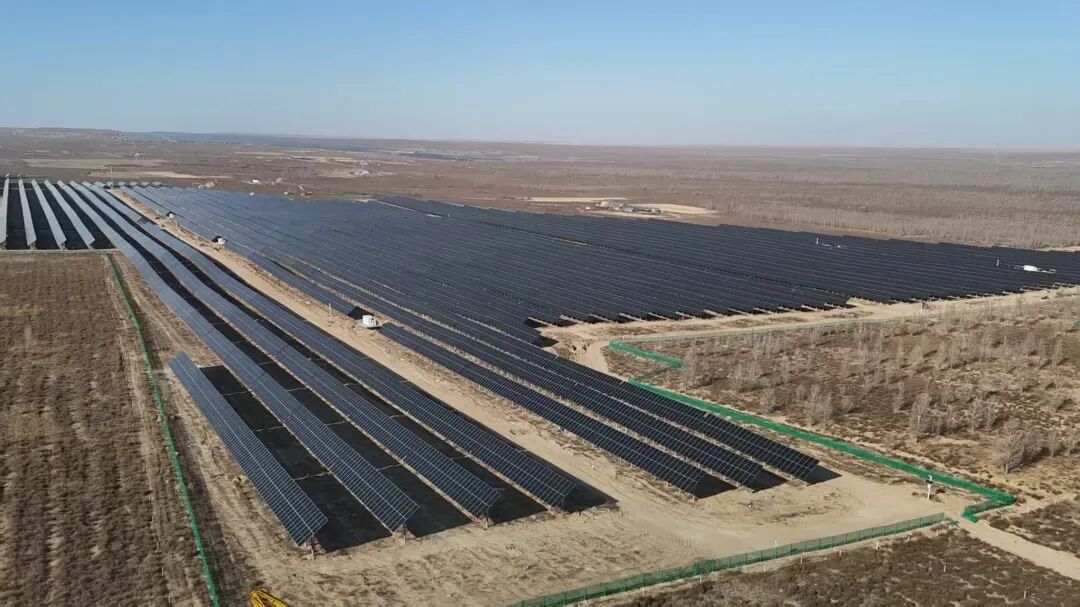
This project is a key initiative under the autonomous region’s strategy to integrate sand control and desertification prevention with wind and photovoltaic power development. It is planned to have a total installed capacity of 500 MW, with a dedicated 220kV step-up substation. The generated power will be transmitted via a single-circuit 220kV transmission line to the Gushanliang 500kV substation, ensuring stable delivery of green electricity. The project employs a three-dimensional ecological restoration model of “power generation on the panels, land rehabilitation beneath the panels, and crop cultivation between the panels,” effectively integrating photovoltaic power generation with desertification control. It has simultaneously restored 60,000 mu of degraded land, including 12,000 mu rehabilitated directly beneath the solar panels and 48,000 mu treated in other locations, thereby achieving synergistic benefits between PV power generation and desertification prevention and control. It is expected that once the project reaches full capacity and commences commercial operation, its average annual grid-connected electricity generation will be approximately 852 million kWh. This is equivalent to saving 257,600 tonnes of standard coal annually and reducing carbon dioxide emissions by 1.0211 million tonnes, thereby further advancing the region’s energy transition and low-carbon development. During implementation, the project has placed strong emphasis on technological innovation and the integration of industry, academia, and research. In collaboration with Inner Mongolia Agricultural University, it has jointly established the “Inner Mongolia Institute for New Energy and Ecological Sustainable Development” and the “Key Laboratory of Photovoltaic Sand Control in Inner Mongolia.” These institutions focus on R&D of core technologies for photovoltaic sand control, the commercialization of research outcomes, and talent cultivation, thereby progressively establishing a sustainable development system characterized by a virtuous cycle that links ecological restoration, clean energy, industrial incubation, and human resource development. The Phase I 500 MW photovoltaic integrated project for sand control and desertification mitigation in Dalat Banner, undertaken by Inner Mongolia Energy Group, is another vivid example of Dalat Banner’s innovative approach to using photovoltaic technology to combat desertification, continuously advancing the coordinated development of desert remediation and the new energy industry.