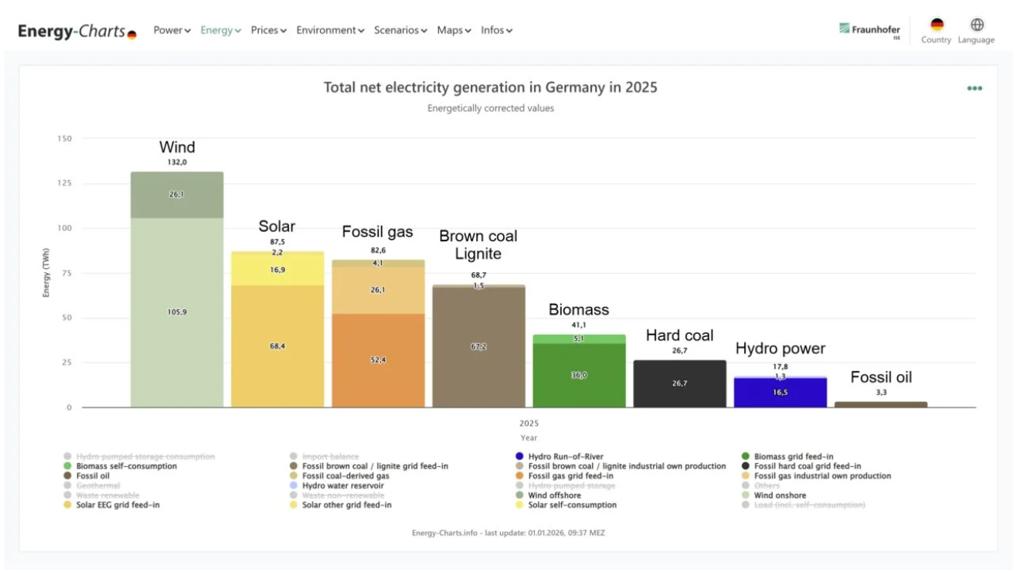
For the first time, Germany’s solar PV generation has surpassed lignite-fired power generation, ranking second only to wind power. Image source: Fraunhofer Institute for Solar Energy Systems (Fraunhofer ISE)/energy-charts.info data platform.
In 2025, the new installed capacity of solar photovoltaic power will be comparable to the data registered by Germany’s Federal Network Agency in 2024. However, to achieve its 2026 target, Germany needs to significantly increase its installed solar PV capacity, adding 22GW by 2026. As Germany’s installed solar PV capacity continues to grow, solar PV power generation reached 87TWh in 2025, a 21% increase over the previous year.
Most of the electricity generated (71 TWh) was fed into the public grid, while 16.9TWh was used for on-site consumption, up from 12.2TWh in 2024. Since 2022, driven by high electricity prices and the growing adoption of energy storage technologies, interest in self-consumption of electricity has been steadily increasing in Germany. An analysis by the Fraunhofer Institute for Solar Energy Systems indicates that the growth in solar power generation expected by 2025 is not unique to Germany, but rather a trend across the entire European Union. For the first time, solar PV generation in the European Union surpassed the combined output of lignite and hard coal, reaching 275 TWh, while the combined generation from lignite and hard coal totaled 243 TWh. Over the past decade, solar photovoltaic power generation has doubled, while coal-fired power generation has declined by 60%. Furthermore, on June 20, 2025, the German power grid recorded a new all-time high in solar PV generation capacity connected to the grid, reaching 50.4GW between 12:45 PM and 1:00 PM. During this period, solar photovoltaic power generation accounted for nearly the entire grid-connected electricity load (98.6%). One day later, solar power generation accounted for the highest share of the day’s total electricity load, reaching 41.2%. In 2025, solar photovoltaic will not be the only renewable energy source experiencing substantial growth. Last year, Germany’s installed capacity of large-scale battery energy storage systems increased from 2.3GWh to 3.7 GWh, a 60% rise. Currently, Germany’s total installed battery storage capacity is nearly 25 GWh, with 20GWh accounted for by residential energy storage systems.
The rise of large-scale battery energy storage is fundamentally transforming how Germany’s power system operates. “While its impact on short-term flexibility is already evident, the system-level effects, such as those on peaking power plants, can currently only be estimated,” explained Leonhard Gandhi, project manager of the Energy Charts initiative at the Fraunhofer Institute for Solar Energy Systems. “These developments necessitate that battery energy storage be explicitly factored into expansion planning, system planning, and power market design.”